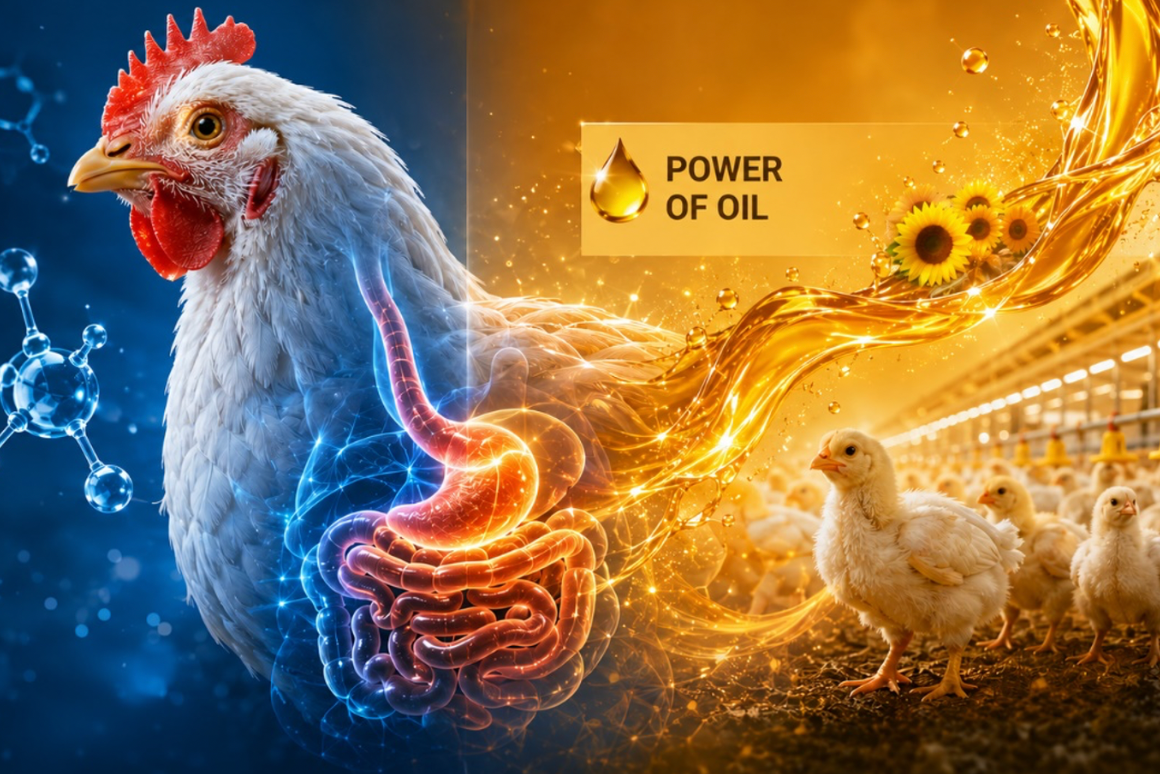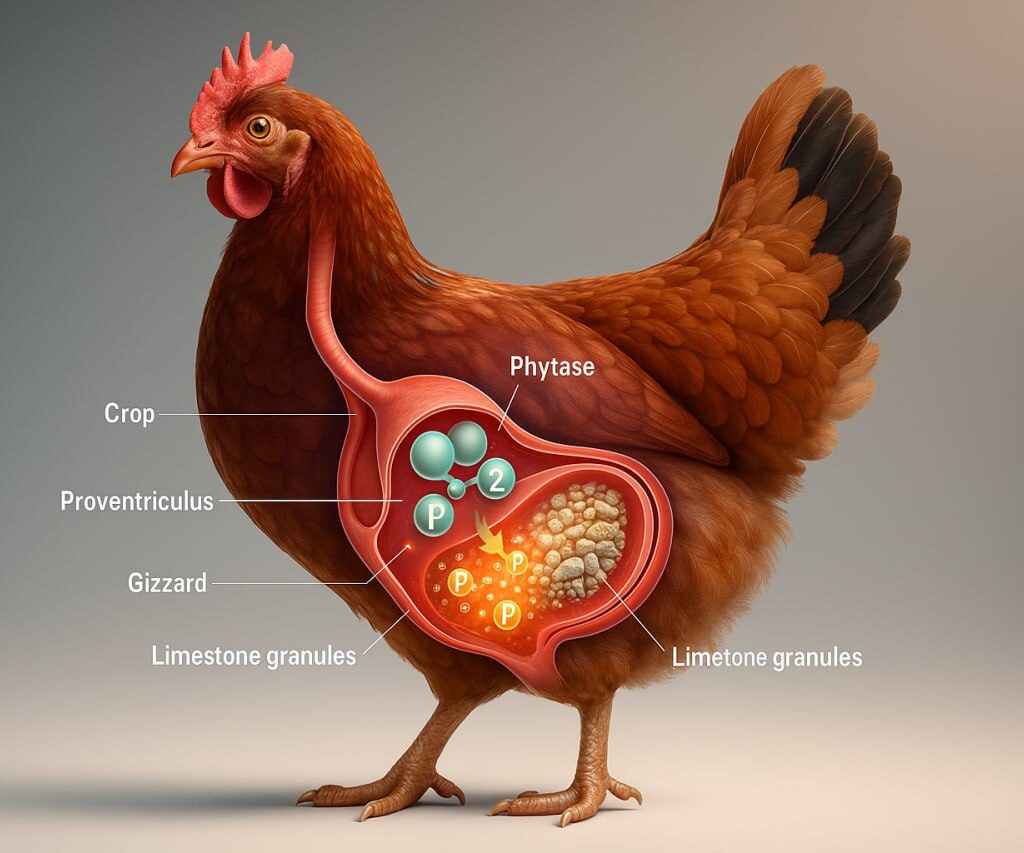
A poultry diet is not just a mixture of nutrients — it is a biochemical system where tiny reactions can shape the success of the entire farm. At the core of this system are three key players: phytate, phytase, and limestone.
Their daily “battle for phosphorus” in the bird’s digestive tract determines not only bone strength and eggshell quality, but also feed cost efficiency and environmental impact.
Phytate is the natural storage form of phosphorus in cereals and oilseed meals. The challenge is that birds cannot digest it on their own. Without phytase, only about 20–30% of total phosphorus is available, while the rest is excreted.
With the addition of phytase, this changes dramatically — the enzyme unlocks phytate, releasing up to 70–80% of bound phosphorus for absorption and utilization.
Phytase is not just another enzyme; it is the key to unlocking “hidden phosphorus,” reducing the need for inorganic phosphates, and improving feed efficiency.
Limestone — friend or foe?
Calcium is essential for strong bones and eggshell formation, but when present in excess, it can interfere with phytase activity. Excess calcium binds with phytate, forming insoluble calcium-phytate complexes that even the best enzyme cannot break down. Here, limestone particle size plays a critical role.
Fine limestone dissolves quickly and “reaches” phytate before phytase does, reducing enzyme efficiency. Larger particles dissolve more slowly, giving phytase time to act and release phosphorus before calcium binds to it. Therefore, combining different particle sizes often delivers the best results — coarse particles support calcium availability later, while phytase completes its work in the early stages of digestion.
The delicate balance between calcium and phytase
Research shows that as dietary calcium levels increase, phytase activity can decrease by 15–20% or more. Even a perfectly dosed enzyme will not perform efficiently if calcium is supplied in excess.
This is why balancing the Ca:P ratio and selecting the right limestone source are critically important. The correct combination of particle sizes provides phytase with both the “space” and the “time” to act.
Conclusion
Poultry nutrition is not just about numbers — it is precise chemistry in motion. Phytase, phytate, and limestone form an interactive system where even a micron can make a difference. A well-balanced formulation reduces the use of inorganic phosphates, strengthens bones, improves eggshell quality, and minimizes phosphorus losses to the environment.
From this perspective, limestone particle size is not a trivial detail but a strategic tool for nutrient bioavailability and cost optimization. This defines the philosophy of AVA GROUP: intelligent nutrition, where every gram of phosphorus matters, and even the smallest limestone particle contributes to your performance.