vykorystannia-ekzohennykh-emulhatoriv

THE USE OF EXOGENOUS EMULSIFIERS IN BROILER NUTRITION: TECHNOLOGICAL ADVANTAGES AND ECONOMIC EFFICIENCY

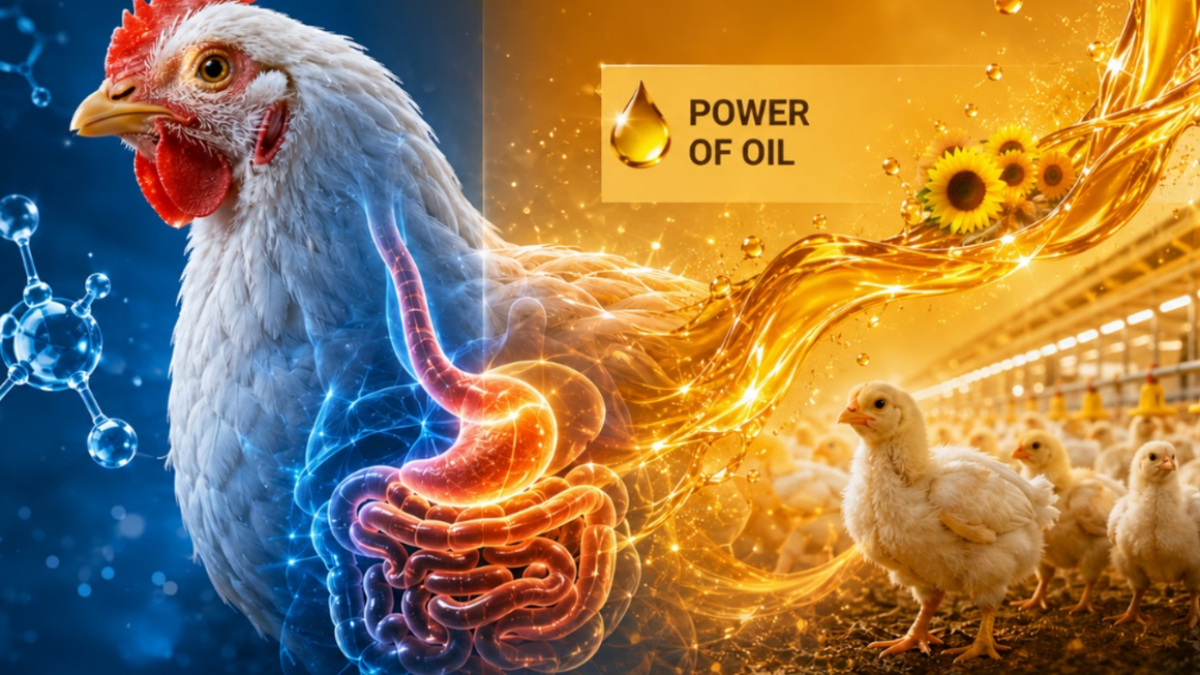
The efficiency of modern poultry farming directly depends on the energy balance of the diets. To sustain the high growth rates of modern broiler crosses, concentrated energy sources, such as vegetable oils (sunflower, soybean) and animal fats, are essential components of compound feed.

Fats possess the highest caloric value but are concurrently the most expensive feed ingredients. However, due to the physiological specificities of the avian digestive system, a significant portion of lipids may remain unabsorbed, leading to cost overruns and reduced flock performance. To address this issue, modern feed manufacturing utilizes exogenous emulsifiers.

Physiological Background: Why Does Lipid Absorption Profiling Fail?

The most critical period in broiler production is the first 21 days of life (the starter phase). During this time, the chick’s digestive system is still developing: endogenous secretion of the lipase enzyme is limited, and bile acid synthesis is insufficient.

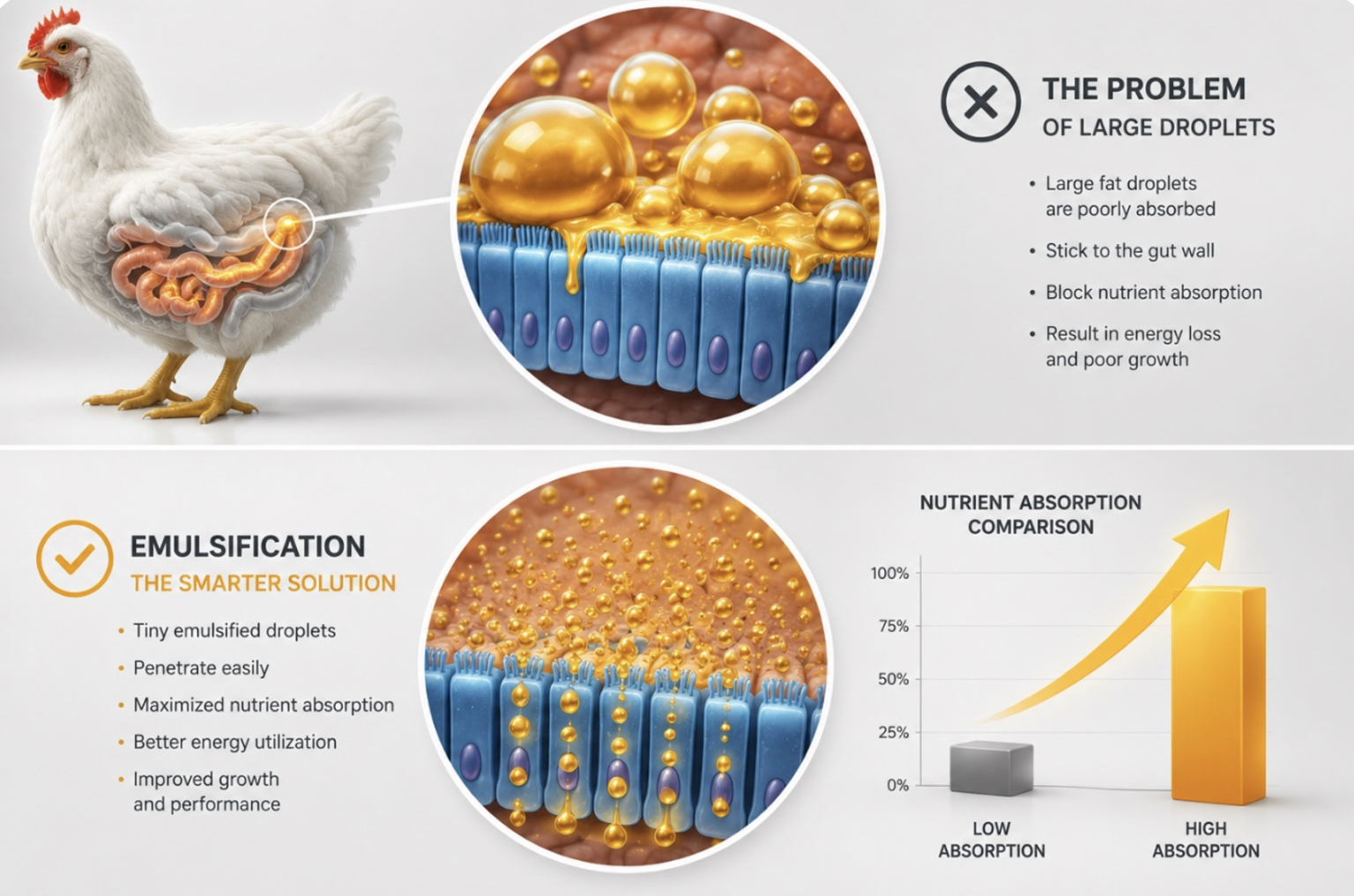
Since the intestinal environment of poultry is aqueous, dietary fats cannot naturally mix with chyme and instead coalesce into large droplets. This triggers several negative consequences:

  • Low Enzyme Accessibility: Lipase can break down fat only at the droplet surface. The large size of fat globules minimizes the contact surface area with the enzyme, causing most of the fat to pass through the digestive tract undigested.
  • Blocking of Other Nutrients: Undigested lipids form a thin hydrophobic film on the intestinal walls. This barrier impedes enzyme access to proteins and carbohydrates, thereby impairing their absorption.
  • Risk of Dysbacteriosis: An excess of undigested fats in the lower gastrointestinal tract serves as a nutrient substrate for the proliferation of pathogenic microflora.
Mode of Action and Classification of Exogenous Emulsifiers

Exogenous emulsifiers act as stabilizers in “oil-in-water” systems. They lower the interfacial surface tension and break down large fat conglomerates into millions of finely dispersed microdroplets (micelles). This increases the surface area available for lipase hundreds of times over, ensuring complete hydrolysis and rapid absorption of fatty acids through the intestinal walls.

In feed formulation technology, several primary groups of emulsifiers are used:

  1. Modified Phospholipids (Lysolecithins): These possess an optimal balance between hydrophilic and lipophilic properties. They are highly effective in diets dominated by vegetable oils, ensuring the formation of stable micromicelles and enhancing the absorption of fat-soluble vitamins.
  2. Highly Hydrophilic Promoters (Polyethylene Glycol Ester-Based): These feature a maximum Hydrophilic-Lipophilic Balance (HLB) index. Specifically designed to operate in strictly aqueous environments, these components efficiently emulsify even complex, poorly soluble animal fats with high melting points.
  3. Complex Plant Phyto-Emulsifiers: These combine the functions of an emulsifier and a hepatoprotector. Due to active extracts such as silymarin and cynarin, they additionally stimulate liver cells to secrete a greater volume of endogenous bile salts.
Economic and Zootechnical Benefits for Producers

Integrating emulsifiers into the feeding program yields substantial financial returns driven by several key factors:

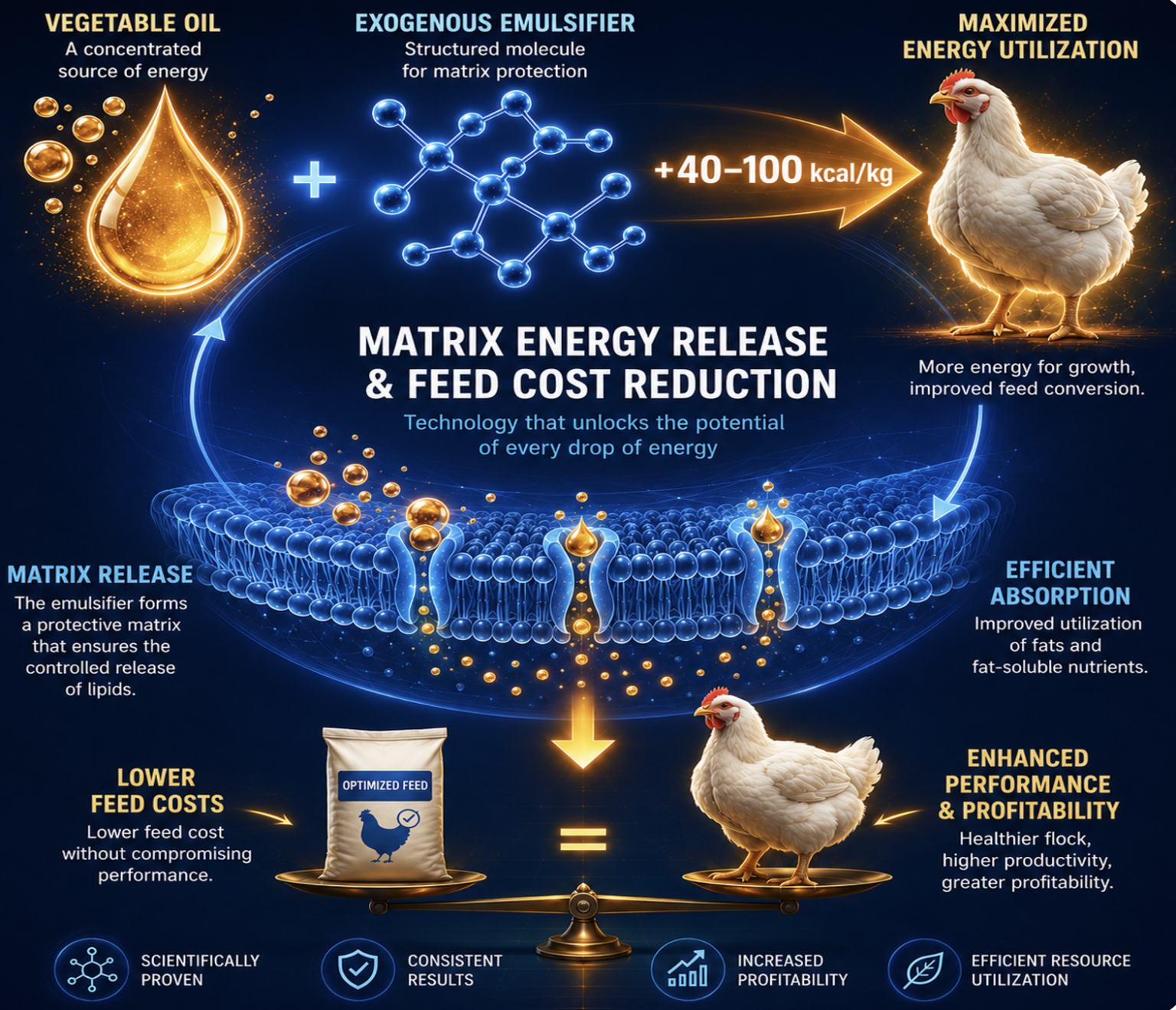
  • Diet Cost Optimization (Matrix Approach): Because the efficiency of fat utilization increases significantly, producers can reduce the inclusion rate of expensive pure oil in the compound feed (by approximately 5–15 kg per metric ton of feed). Least-cost formulation software factors in the released energy value (ranging from 40 to 100 kcal/kg depending on the product type), allowing for a reduction in the cost per ton of feed without compromising its nutritional value.
  • Improved Feed Conversion Ratio (FCR): Maximizing nutrient absorption reduces feed intake per unit of body weight gain.
  • Enhanced Flock Uniformity: The additive compensates for the immature enzymatic systems of weaker chicks during the initial phase, thereby minimizing culling rates and delivering a highly uniform flock weight at the end of the production cycle.

Conclusion

The application of exogenous emulsifiers in broiler compound feed is an economically viable technological solution. It enables poultry enterprises and commercial farms to cut costs on fat ingredients, boost bird productivity, and optimize the overall production cost of the final output.

cover

СANNIBALISM IN POULTRY: A DEEP DIVE INTO THE PROBLEM, CAUSES, CONSEQUENCES, AND PRACTICAL SOLUTIONS

Cannibalism in poultry is not merely a rare behavioral anomaly. It is a widespread, complex, and often overlooked issue that affects a farm’s health, welfare, and economic performance. Regardless of the poultry species—layers, broilers, turkeys, or breeders—under certain conditions, birds may start pecking each other, sometimes to the point of death. If timely measures are not taken, this can lead to catastrophic consequences. The process always has deep-rooted causes. Pecking behavior is natural for birds. But when instincts turn into aggression towards conspecifics, it reflects a breakdown in adaptive mechanisms, often due to improper feeding or management.

WHAT IS CANNIBALISM IN BIRDS?

Cannibalism is a pathological behavior in which birds peck and injure other birds, often eating feathers, skin, or even internal organs. Several forms are recognized:

  1. Feather pecking — birds pluck and consume feathers, especially on wings, tails, and backs. This leads to exposed skin, becoming a target for deeper injuries.
  2. Cloacal cannibalism — a hazardous form. During or after egg-laying, the cloaca protrudes and becomes bright red, attracting other birds that begin pecking at it. This often results in death.
  3. Tissue pecking — development of deep wounds, consumption of muscles, blood, and sometimes internal organs. The consequences are painful and often fatal.

Fact: Just 3–5% of aggressors in a flock can create a constant crisis in the poultry house.

CAUSES:

Cannibalism does not occur without cause. It is always a result of stress, nutritional deficiencies, or housing problems. The most common reasons include:

  1. Nutritional Deficiencies

Lack of high-quality protein, methionine, lysine, sodium, and sulfur reduces vitality, irritability, and behavioral deviations. When the diet fails to meet basic physiological needs, birds search for alternative sources—such as feathers. Initially, this behavior is compensatory rather than aggressive.

Interesting: Studies show that birds fed diets with animal protein exhibited less feather pecking than those fed only plant-based proteins.

  1. Lighting

Birds are susceptible to light. Excessive brightness or constant lighting causes overexcitement, restlessness, and aggression. Bright light near nest boxes is hazardous, as it highlights the blood-rich cloaca during egg-laying.

  1. Behavioral Boredom

Birds have a natural need to explore, peck, and move. If the poultry house lacks enrichment (just floor and feeder), pecking is redirected toward flock mates—even with optimal feeding. Boredom is a severe stressor.

  1. Overcrowding

High stocking density creates spatial stress. The inability to escape or avoid others is a key trigger for aggression. Stress is unevenly distributed—weak birds become victims more often.

  1. Diseases and Parasites

Sick or infested birds behave and look differently, attracting attention. For example, mites cause itching, leading to feather loss and exposed skin, which can trigger a chain reaction.

HOW TO RECOGNIZE THE PROBLEM?

Signs are often subtle. Watch for:

  1. Feather loss in specific areas;
  2. Blood stains or dried blood in nests;
  3. Unusual vocalizations in the house;
  4. Changes in behavior—birds isolating themselves or acting anxious;
  5. Uneven flock appearance.

Tip: Enter the poultry house quietly and unexpectedly. Observe silently for 5–10 minutes to assess the real situation.

BUSINESS IMPACT

Cannibalism is not only a welfare issue—it causes direct financial losses:

  1. 10–30% drop in egg production;
  2. Up to 40% increased feed intake in featherless birds;
  3. Injuries, mortality, and increased veterinary costs;
  4. Deterioration in carcass quality.

HOW TO PREVENT CANNIBALISM

Feeding

  1. Maintain a stable, well-balanced diet rich in amino acids, trace elements, and fiber;
  2. Avoid sudden changes in feed formulation;
  3. Use feed additives that reduce excitability.

Lighting Management

  1. Avoid excessive brightness. Light in nest areas should not exceed 1 lux.

Environmental Enrichment

  1. Use straw bales, corn cobs, pecking blocks;
  2. Provide perches, platforms, and varied surfaces.

Flock Management

  1. Isolate injured and aggressive birds;
  2. Monitor flock uniformity: body weight, age, activity;
  3. Daily behavior monitoring.

Early Prevention

  1. Provide toys, bedding, and sand access from day one;
  2. Introduce birds gradually to new environments;
  3. Use infrared beak treatment for selected batches.

CONCLUSION

Cannibalism is not the deviation of a single bird—it’s a reflection of systemic problems. When pecking arises, it indicates nutritional, psychological, or spatial overload. The task of farm management is to detect, localize, and neutralize the source in time.

The deeper you understand your flock, the lower the risk it will “turn on itself.”

Read more about solutions for quail, turkeys and other poultry>>

bird-feather

BIRD FEATHERS: A BIOLOGICAL SHIELD AND A MIRROR OF YOUR FARM

When a farmer notices birds losing feathers, the first thought is usually molting or “something’s wrong with the feed.” But feathers aren’t just a surface layer. They’re a complex, sensitive system that reacts first to invisible problems within the farm.

FEATHERS SHOW WHAT YOU CAN’T SEE

Feathers aren’t decoration. They’re a physiological structure essential for survival. They:

  • regulate heat exchange (if it fails, the bird wastes energy on heating);
  • protect the skin from damage, bacteria, and moisture;
  • help the bird survive in a hierarchical flock;
  • serve as a means of communication (including aggression/submission behaviors).

Feathers are organs with structure, follicles, blood supply, and even built-in “durability,” like a flexible design. And they require particular “fuel” to grow.

FEATHERS AS RESOURCE CONSUMERS

Few realize that feather formation is one of the most resource-intensive processes in a bird’s body. It’s not just about protein — it also needs microelements, enzymes, energy, and vitamins.

Feathers are made of β-keratin, which forms only in the presence of methionine, cystine, biotin, zinc, and other nutrients.

Even a slight deficiency of any of these — the feathers grow brittle, deformed, and weak.

And importantly — the bird’s body never prioritizes feathers. If there’s a shortage, resources go to vital organs first. Feathers suffer first.

Fun fact: Some studies show that during mild protein deficiency, birds maintained productivity, but their feathers were already in poor condition. The farmer saw the signal — but didn’t act because feed intake and weight weren’t dropping.

BEHAVIOR WRITES ON FEATHERS TOO

Feather pecking is biologically rooted. It’s not just aggression or “nervous birds.” Often, it’s:

  • an attempt to get protein under deficiency;
  • a reaction to stress, overcrowding, and bright light;
  • a result of lack of stimulation (especially in intensive systems).

Sometimes, it starts “out of nowhere” but continues for months. It triggers a chain reaction: birds get injured → feathers are damaged → more attention from others → more trauma → flock health declines.

Insight often overlooked: The location of feather loss matters. If it’s the back, wings, or tail — it’s likely pecking or rubbing due to crowding. If it’s the chest or belly — it might be contact dermatitis (from litter, ammonia, moisture).

FEATHERS AND SKIN — ONE SYSTEM

Feathers grow in close interaction with skin, follicles, and microcirculation.

Interesting fact: Feathers grow only in specific zones — pterylae. The rest of the skin is “empty” (apteriae). Nature designed it this way to reduce weight and allow mobility. But it also means every damaged follicle is a long-term local loss. Also:

  • feather follicles have a capillary network;
  • feathers self-repair thanks to microscopic hooks;
  • the bird needs strength and resources to maintain this system.

If the diet contains mycotoxins or liver function is impaired — feathers may grow deformed or fail to regenerate after molting.

WHAT REALLY AFFECTS FEATHER QUALITY?

  • Complete nutrition. No compromises. Without methionine — there are no feathers, even if “protein is present.”
  • Gut health. Digestive issues = poor nutrient absorption.
  • Microclimate. Ammonia + wet litter = contact dermatitis, skin burns, disrupted feather growth.
  • Stocking density. More crowding = more mechanical damage.
  • Parasite-free environment. Lice, mites, and fungi — all target feathers. Birds will peck them off.

INSTEAD OF A CONCLUSION — A REMINDER

Feathers reflect what’s going on inside the bird. They don’t lie. They don’t mask. They don’t stay silent. You have to know how to read them. They show:

  • what the bird eats,
  • how much stress it’s under,
  • what the barn temperature is,
  • how the liver is functioning,
  • if there’s competition for space.

Sometimes, all it takes is a closer look at the feathers to diagnose the whole farm. And that’s not just “bird stuff.” That’s a strategy.

Learn more about solution for quails, turkeys and other poultry>>